High-performance PQC hardware
Parallel and unified polynomial cores that run every multiplication ML-KEM and ML-DSA need. ParallelNTT cuts NTT latency 24× on UltraScale+ FPGAs.
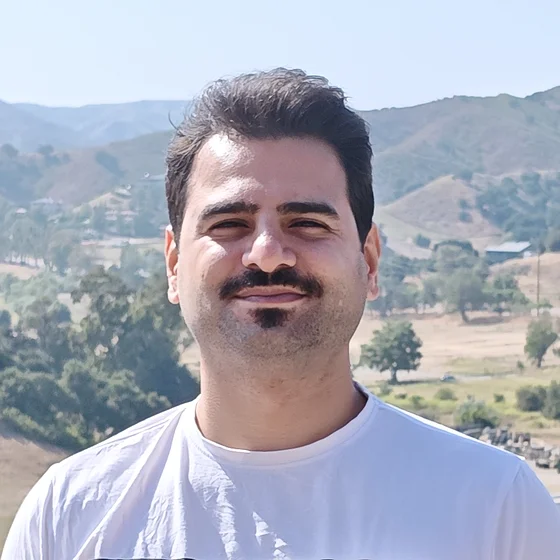
PhD Candidate, Florida Atlantic University · Cryptographic Hardware Engineer, PQSecure
Boca Raton, Florida · Born July 23, 1994
I design hardware for post-quantum cryptography. My work covers the polynomial arithmetic behind ML-KEM and ML-DSA, from tiny cores for IoT devices to fully parallel FPGA accelerators. I'm now extending this work to FALCON (FN-DSA).
Parallel and unified polynomial cores that run every multiplication ML-KEM and ML-DSA need. ParallelNTT cuts NTT latency 24× on UltraScale+ FPGAs.
Cores for constrained devices. KNightCore multiplies ML-KEM polynomials with zero DSP blocks; LightNTT uses a constant-geometry pipeline.
New work on hardware for FALCON, the NTRU-lattice signature scheme NIST is standardizing as FN-DSA, with its floating-point FFT and Gaussian sampling.
Masking and shuffling for polynomial arithmetic, and power-analysis attacks on hardware ML-DSA in a post-quantum root of trust.
High-Performance Post-Quantum Cryptographic Engineering in Hardware
HyperPoly: A High-Throughput Unified Core for Full-Spectrum Polynomial Arithmetic of ML-KEM and ML-DSA
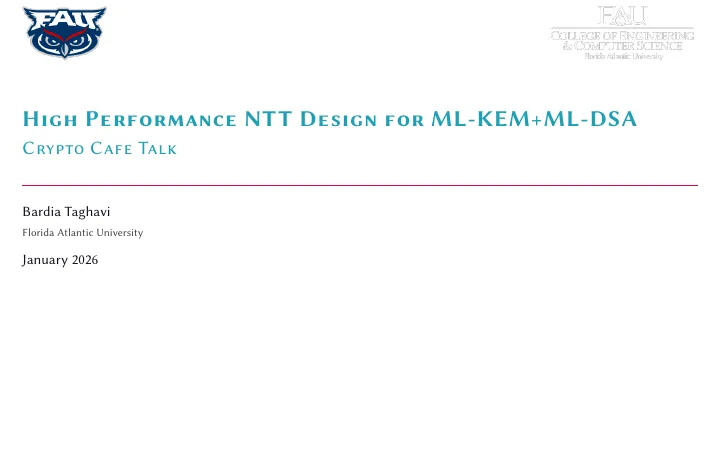 Two Birds, One Stone: high-performance NTT design for ML-KEM and ML-DSA
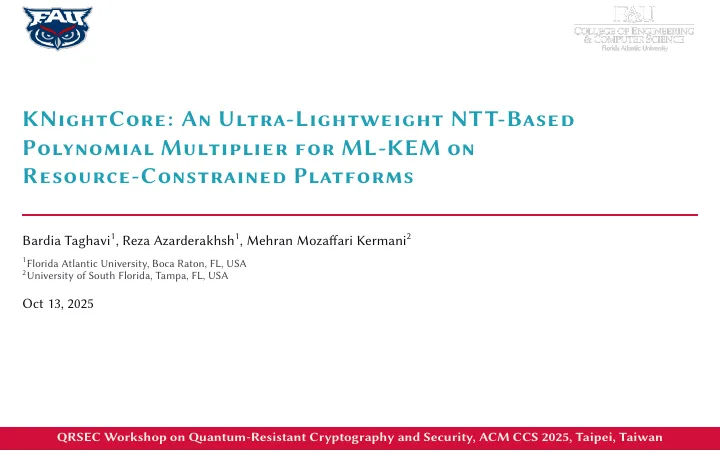 KNightCore: ultra-lightweight polynomial multiplier for ML-KEM
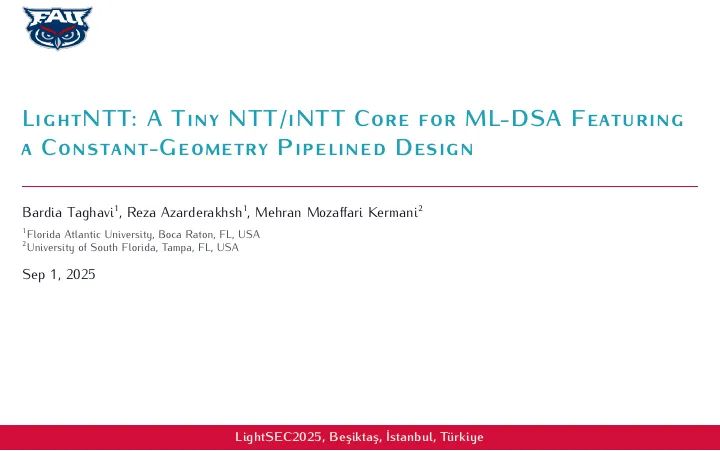 LightNTT: a tiny NTT/iNTT core for ML-DSA
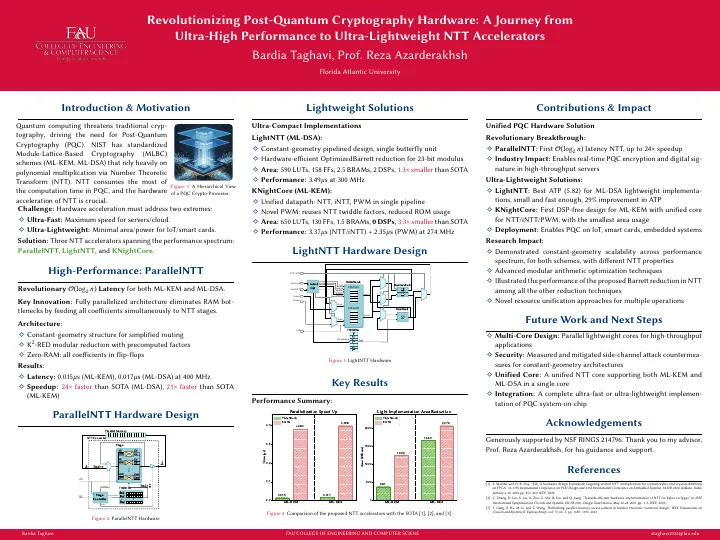 From ultra-high-performance to ultra-lightweight NTT accelerators
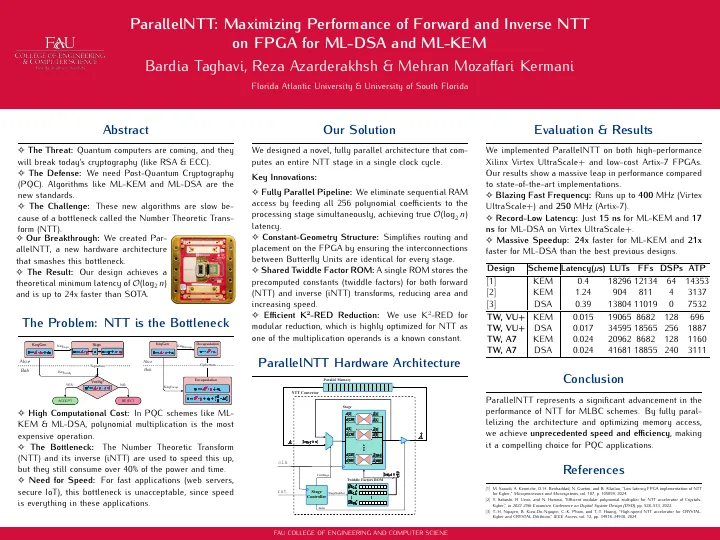 ParallelNTT: maximizing NTT performance on FPGA
Crypto Cafe slides: PDF. A companion Jupyter notebook that implements ML-KEM and ML-DSA in pure Python (download .ipynb).
A three-part lecture series on post-quantum cryptography, from first principles to the internals of ML-KEM and ML-DSA.
 Introduction to post-quantum cryptography
 Basics of KEMs and digital signatures
 ML-KEM and ML-DSA, advanced
TA and lab instructor at FAU for Advanced FPGA Design, Cryptographic Engineering, Structured VLSI Design and Design of Digital Systems.
PQSecure Technologies · Boca Raton, FL
Post-quantum cryptography IP cores: arithmetic units for ML-KEM and ML-DSA across several architectures, from compact to high-throughput.
Florida Atlantic University · Cryptography & hardware design
PQC accelerators for ML-KEM and ML-DSA on Xilinx FPGAs, under Dr. Reza Azarderakhsh and Dr. Mehran Mozaffari Kermani.
Advanced Service Robots Lab, University of Tehran
Deep-learning gait analysis for amputee subjects on Raspberry Pi, with an STM32-based data acquisition system.
Florida Atlantic University
University of Tehran
K. N. Toosi University of Technology
Reviewer for IEEE HOST 2025 and 2026, ARITH 2026, IEEE Transactions on Computer-Aided Design (TCAD) and IACR Transactions on Cryptographic Hardware and Embedded Systems (TCHES).
For research collaboration, talks or PQC hardware questions: bardia.taghavi@pqsecurity.com or staghavi2024@fau.edu.